
Main menu

  • HOME
  • ARTICLES
    • Current Issue
    • Abstracts In Press
    • Archives
    • Special Issue Archive
    • Subject Collections
  • INFO FOR
    • Authors
    • Reviewers
    • Call For Papers
    • Subscribers
    • Advertisers
  • SUBMIT
    • Manuscript
    • Peer Review
  • ABOUT
    • The JABFM
    • The Editing Fellowship
    • Editorial Board
    • Indexing
    • Editors' Blog
  • CLASSIFIEDS
  • Other Publications
    • abfm

User menu

Search

  • Advanced search
American Board of Family Medicine
  • Other Publications
    • abfm
American Board of Family Medicine

American Board of Family Medicine

Advanced Search

  • HOME
  • ARTICLES
    • Current Issue
    • Abstracts In Press
    • Archives
    • Special Issue Archive
    • Subject Collections
  • INFO FOR
    • Authors
    • Reviewers
    • Call For Papers
    • Subscribers
    • Advertisers
  • SUBMIT
    • Manuscript
    • Peer Review
  • ABOUT
    • The JABFM
    • The Editing Fellowship
    • Editorial Board
    • Indexing
    • Editors' Blog
  • CLASSIFIEDS
  • JABFM on Bluesky
  • JABFM On Facebook
  • JABFM On Twitter
  • JABFM On YouTube
Research ArticleOriginal Research

Improving Efficiency While Improving Patient Care in a Student-Run Free Clinic

Jason S. Lee, Kristen Combs, KNIGHTS Research Group 2016 and Magdalena Pasarica
The Journal of the American Board of Family Medicine July 2017, 30 (4) 513-519; DOI: https://doi.org/10.3122/jabfm.2017.04.170044
Jason S. Lee
From the Department of Medical Education, University of Central Florida College of Medicine, Orlando.
BS
  • Find this author on Google Scholar
  • Find this author on PubMed
  • Search for this author on this site
Kristen Combs
From the Department of Medical Education, University of Central Florida College of Medicine, Orlando.
BS
  • Find this author on Google Scholar
  • Find this author on PubMed
  • Search for this author on this site
From the Department of Medical Education, University of Central Florida College of Medicine, Orlando.
Magdalena Pasarica
From the Department of Medical Education, University of Central Florida College of Medicine, Orlando.
MD, PhD
  • Find this author on Google Scholar
  • Find this author on PubMed
  • Search for this author on this site
  • Article
  • Figures & Data
  • References
  • Info & Metrics
  • PDF
Loading

Article Figures & Data

Figures

  • Tables
  • Figure 1.
    • Download figure
    • Open in new tab
    Figure 1.

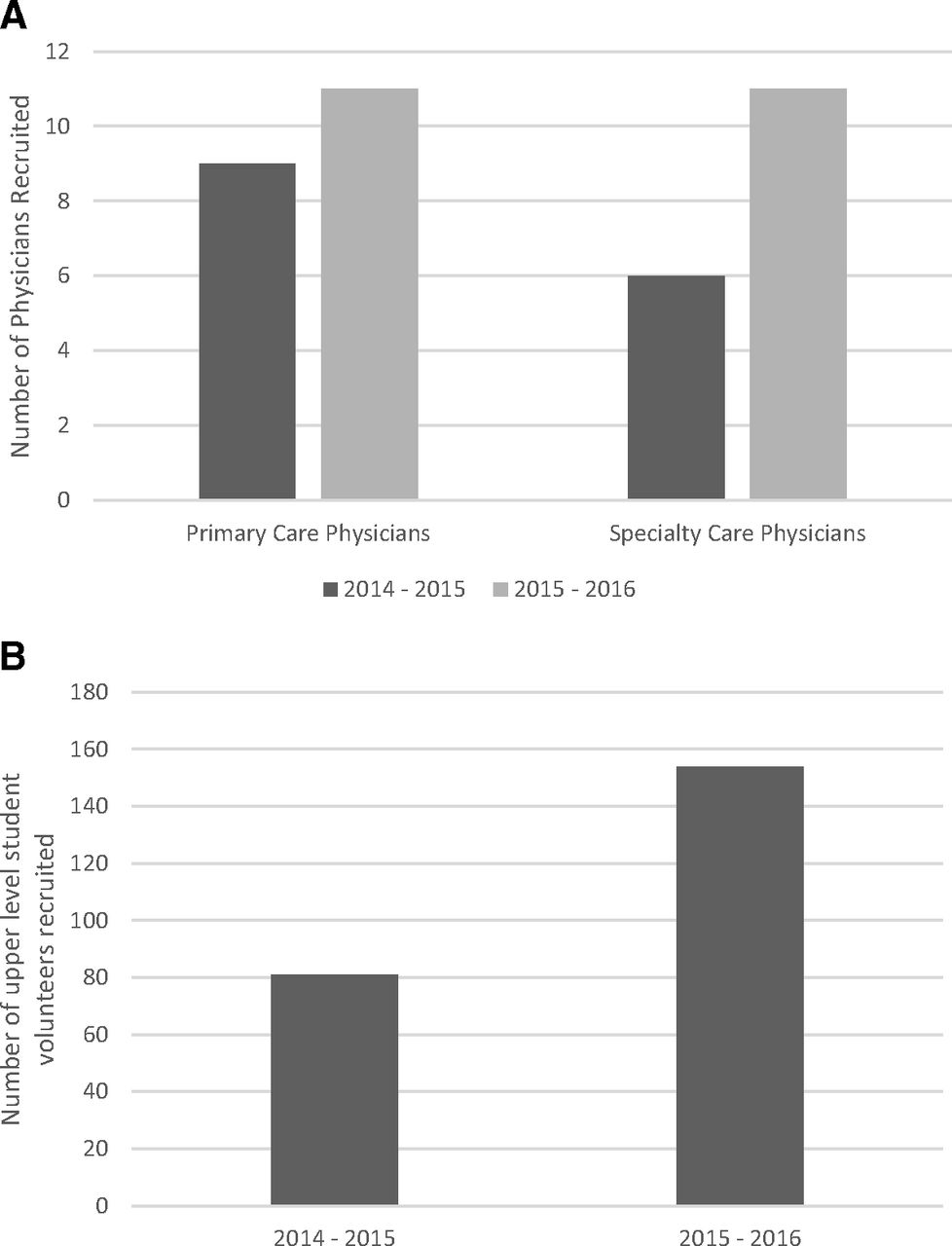
    Change in the recruitment of volunteer physicians and supervising student-providers from 2014 to 2015 to 2015 to 2016. A: The change in primary and specialty care physician recruitment. B: The number of upper-level (third- and fourth-year) medical students volunteering as supervising student-providers. Values are represented as absolute numbers.

  • Figure 2.
    • Download figure
    • Open in new tab
    Figure 2.

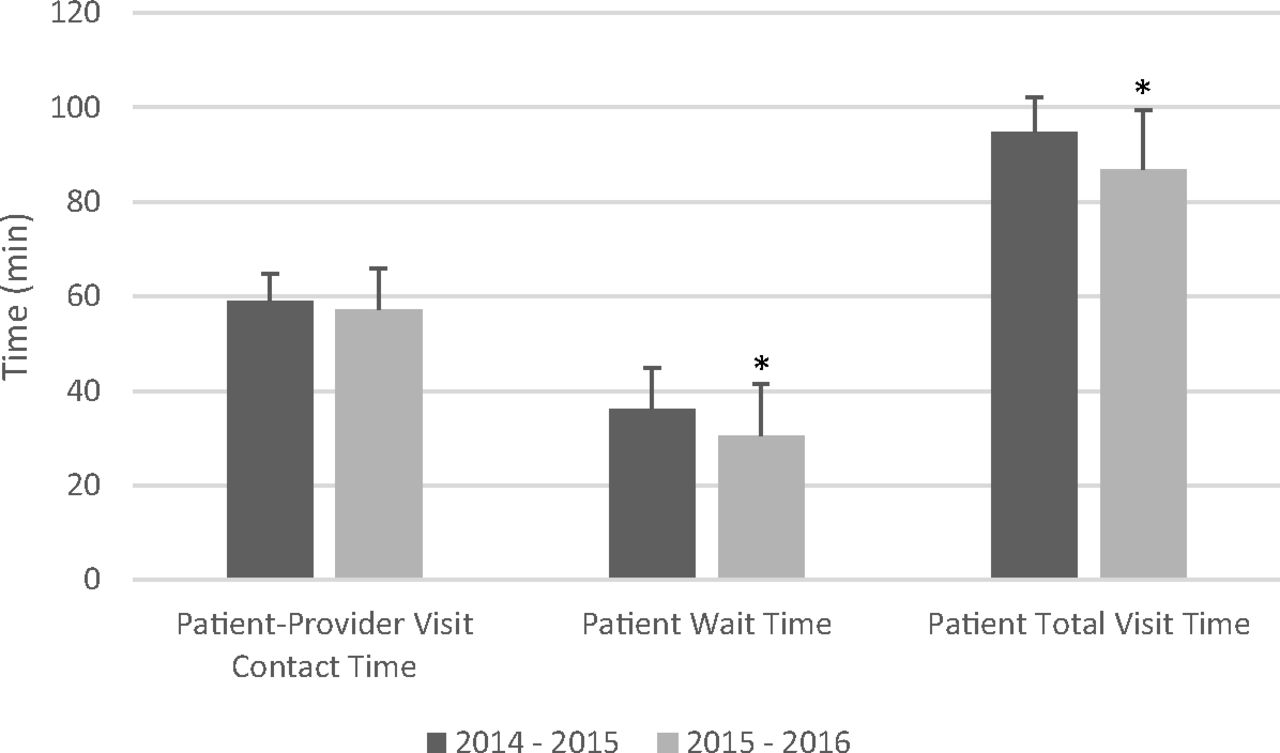
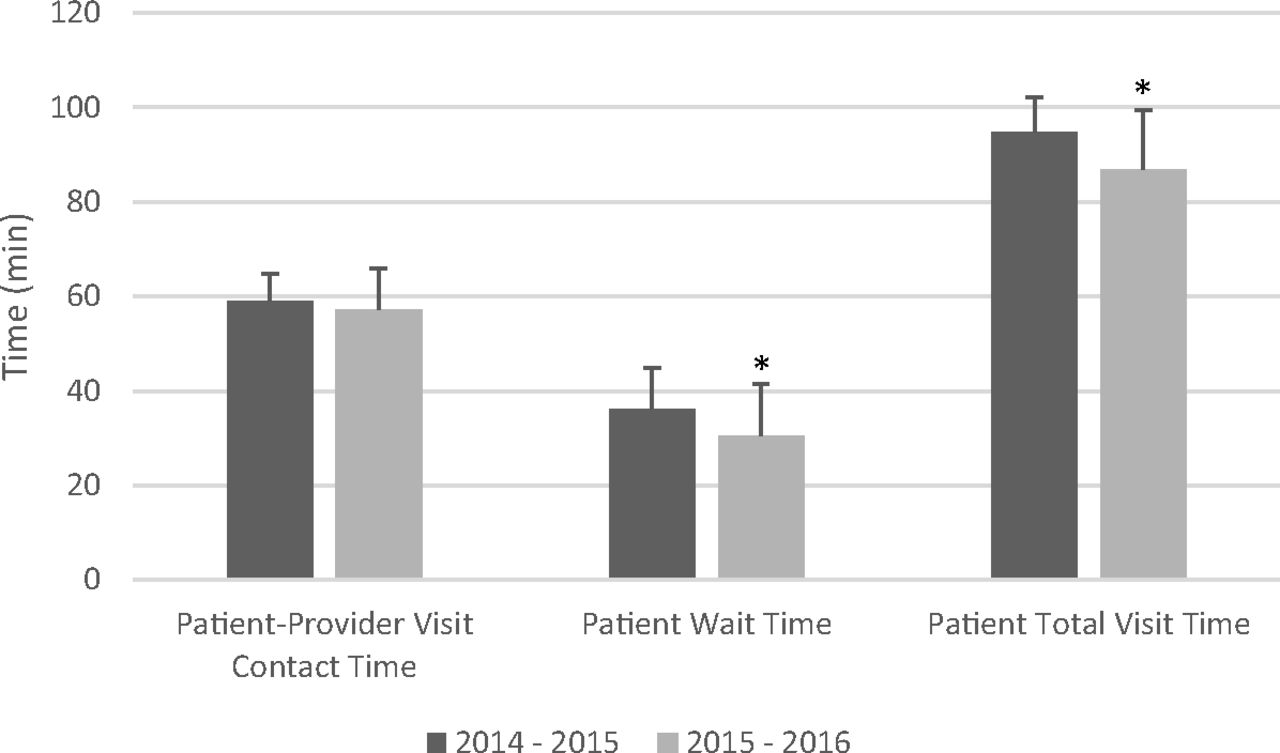
    Medical appointment duration in 2014 to 2015 versus 2015 to 2016. “Patient-provider visit contact time” represents the amount of time patients spent with the providers. “Patient wait time” represents the time spent by the patient in the waiting room and clinic room waiting for providers, procedures, education, lab tests, or medications. “Patient total visit time” represents the time between check-in and check-out. Values are presented as mean ± standard deviation. *P < .05.
Tables

  • Figures
    • View popup
    Table 1.

    Problems Contributing to Clinic Inefficiency, and Proposed Interventions

    Interventions
    Problems with time management and communication
        Patients were roomed late after arrival.All students were instructed to arrive at the clinic at least 30 minutes before the clinic start time in order to review the patient's chart. Second-year students were instructed to review the patient's chart a day in advance of the patient's visit.
    A board member was designated to notify the student-providers of their patient's arrival in order to decrease the time spent in the waiting room.
        Student-providers' responsibilities were split into 9 teams without proper communication and recognition of duties, which increased patient wait time.Each team was instructed to record the time in and out of the patient room.
    Student-care team members adopted the role of measuring vital signs (from student-providers) in order to decrease the wait time between vital signs measurement and the start of history taking.
    Student-providers were instructed to provide student-educators with an “education form” to communicate patient education needs more effectively.
    Student-providers were instructed to provide student-pharmacists with a “medication form” to communicate needed medications more effectively.
        Patients were waiting for the overbooked attending physician to discuss the patient's medical management and discharge plan.The number of patients seen by each physician was decreased from 3 or 4 to 2 or 3 patients.
    The number of physicians participating at each clinic was increased to improve physician availability for each patient.
    Physicians' schedules were confirmed at least 2 months before their clinic date to decrease the number of physician cancellations.
    The pool of supervising student-providers was increased by integrating the internal/family medicine third-year clerkship students into the clinic, thereby increasing the number of patients seen per clinic.
    Periodic surveys were sent to third- and fourth-year students to determine their availability and decrease cancellation frequency.
    A single physician faculty advisor was designated to monitor and manage laboratory results, alongside the student-providers responsible for each patient, to decrease the workload outside of clinic for the other volunteer attending physicians.
    Problems with clinic resources
        Students providing care were slow in processing their duties due to the lack of readily available information.Student-educators were trained on lifestyle education using a free interactive website.
    A written guide for applying to Prescription Assistance Program (PAP) was developed to decrease the wait time between prescribing the medicine and completing the form.
    Student-pharmacists were instructed to verify the PAP medications at the beginning of each clinic in order to decrease wait time for medications dispensed by the PAP.
    An EMR user guide was created and distributed to student-providers (as a self-learning module and printed resource) in order to decrease time spent documenting in the patient chart.
    The number of student-informaticists was increased from 2 to 4 per clinic in order to decrease documentation time.
    Problems with assessing clinic performance
        No baseline data were available for use to improve the quality and efficiency of patient care in the clinic.A research committee was created and met periodically with the purpose of designing research studies to evaluate patient satisfaction and educational benefits for the volunteers.
    All clinic board members were instructed to collect, track, and analyze their own data (time of appointments, number of patients, patients receiving education, physician-to-patient ratios, etc.)
    • In February 2015, overall clinic performance was analyzed and a needs assessment was performed. These interventions were implemented over the next 2 months. The analysis compared outcomes from March 2014 to February 2015 with data from March 2015 to February 2016.

    • EMR, electronic medical record; PAP, Prescription Assistance Program.
PreviousNext
Back to top

In this issue

The Journal of the American Board of Family     Medicine: 30 (4)
The Journal of the American Board of Family Medicine
Vol. 30, Issue 4
July-August 2017
  • Table of Contents
  • Table of Contents (PDF)
  • Cover (PDF)
  • Index by author
Print
Download PDF
Article Alerts
Sign In to Email Alerts with your Email Address
Email Article

Thank you for your interest in spreading the word on American Board of Family Medicine.

NOTE: We only request your email address so that the person you are recommending the page to knows that you wanted them to see it, and that it is not junk mail. We do not capture any email address.

Enter multiple addresses on separate lines or separate them with commas.
Improving Efficiency While Improving Patient Care in a Student-Run Free Clinic
(Your Name) has sent you a message from American Board of Family Medicine
(Your Name) thought you would like to see the American Board of Family Medicine web site.
CAPTCHA
This question is for testing whether or not you are a human visitor and to prevent automated spam submissions.
5 + 7 =
Solve this simple math problem and enter the result. E.g. for 1+3, enter 4.
Citation Tools
Improving Efficiency While Improving Patient Care in a Student-Run Free Clinic
Jason S. Lee, Kristen Combs, KNIGHTS Research Group 2016, Magdalena Pasarica
The Journal of the American Board of Family Medicine Jul 2017, 30 (4) 513-519; DOI: 10.3122/jabfm.2017.04.170044

Citation Manager Formats

  • BibTeX
  • Bookends
  • EasyBib
  • EndNote (tagged)
  • EndNote 8 (xml)
  • Medlars
  • Mendeley
  • Papers
  • RefWorks Tagged
  • Ref Manager
  • RIS
  • Zotero
Share
Improving Efficiency While Improving Patient Care in a Student-Run Free Clinic
Jason S. Lee, Kristen Combs, KNIGHTS Research Group 2016, Magdalena Pasarica
The Journal of the American Board of Family Medicine Jul 2017, 30 (4) 513-519; DOI: 10.3122/jabfm.2017.04.170044
Twitter logo Facebook logo Mendeley logo
  • Tweet Widget
  • Facebook Like
  • Google Plus One

Jump to section

  • Article
    • Abstract
    • Methods
    • Results
    • Discussion
    • Conclusions
    • Acknowledgments
    • Notes
    • References
  • Figures & Data
  • References
  • Info & Metrics
  • PDF

Related Articles

  • No related articles found.
  • PubMed
  • Google Scholar

Cited By...

  • Enhancing leadership transitions in student-run clinics: a quality improvement initiative to standardise onboarding
  • Community Needs Assessments in a Student-Run Clinic serving a West Philadelphia Neighborhood
  • In This Issue: Opiates, Tobacco, Social Determinants of Health, Social Accountability for Non-Profit Hospitals, More on PCMH, and Clinical Topics
  • Google Scholar

More in this TOC Section

  • The Family Medicine Learning and Experience (FLEX) Lab: A Collaborative Approach to Advancing Clinical Care and Operations
  • Screening for Firearm Violence Exposure in Adolescents and Young Adults
  • Physician and Practice Characteristics Associated with Family Physician Panel Size
Show more Original Research

Similar Articles

Keywords

  • Access to Health Care
  • Health Care Disparities
  • Continuity of Care
  • Education
  • Patient
  • Health Resources
  • Medical Students
  • Needs Assessment
  • Quality Improvement
  • Quality of Health Care
  • Student Run Clinic
  • Vulnerable Populations

Navigate

  • Home
  • Current Issue
  • Past Issues

Authors & Reviewers

  • Info For Authors
  • Info For Reviewers
  • Submit A Manuscript/Review

Other Services

  • Get Email Alerts
  • Classifieds
  • Reprints and Permissions

Other Resources

  • Forms
  • Contact Us
  • ABFM News

© 2026 American Board of Family Medicine

Powered by HighWire