
Main menu

  • HOME
  • ARTICLES
    • Current Issue
    • Archives
    • Special Collections
    • Abstracts In Press
  • INFO FOR
    • Authors
    • Reviewers
    • Call For Papers
    • Subscribers
    • Advertisers
  • SUBMIT
    • Manuscript
    • Peer Review
  • ABOUT
    • The JABFM
    • The Editing Fellowship
    • Editorial Board
    • Indexing
    • Editors' Blog
  • CLASSIFIEDS
  • Other Publications
    • abfm

User menu

Search

  • Advanced search
American Board of Family Medicine
  • Other Publications
    • abfm
American Board of Family Medicine

American Board of Family Medicine

Advanced Search

  • HOME
  • ARTICLES
    • Current Issue
    • Archives
    • Special Collections
    • Abstracts In Press
  • INFO FOR
    • Authors
    • Reviewers
    • Call For Papers
    • Subscribers
    • Advertisers
  • SUBMIT
    • Manuscript
    • Peer Review
  • ABOUT
    • The JABFM
    • The Editing Fellowship
    • Editorial Board
    • Indexing
    • Editors' Blog
  • CLASSIFIEDS
  • JABFM on Bluesky
  • JABFM On Facebook
  • JABFM On Twitter
  • JABFM On YouTube
Research ArticleOriginal Research

Simulation of ICD-9 to ICD-10-CM Transition for Family Medicine: Simple or Convoluted?

Samuel N. Grief, Jesal Patel, Karl M. Kochendorfer, Lee A. Green, Yves A. Lussier, Jianrong Li, Michael Burton and Andrew D. Boyd
The Journal of the American Board of Family Medicine January 2016, 29 (1) 29-36; DOI: https://doi.org/10.3122/jabfm.2016.01.150146
Samuel N. Grief
From the Departments of Family Medicine (SNG), Biomedical and Health Information Sciences (JP, ADB), and General Internal Medicine (MB), University of Illinois, Chicago; and the Department of Medicine, University of Arizona (YAL, JL).
MD
  • Find this author on Google Scholar
  • Find this author on PubMed
  • Search for this author on this site
Jesal Patel
From the Departments of Family Medicine (SNG), Biomedical and Health Information Sciences (JP, ADB), and General Internal Medicine (MB), University of Illinois, Chicago; and the Department of Medicine, University of Arizona (YAL, JL).
BS
  • Find this author on Google Scholar
  • Find this author on PubMed
  • Search for this author on this site
Karl M. Kochendorfer
From the Departments of Family Medicine (SNG), Biomedical and Health Information Sciences (JP, ADB), and General Internal Medicine (MB), University of Illinois, Chicago; and the Department of Medicine, University of Arizona (YAL, JL).
MD
  • Find this author on Google Scholar
  • Find this author on PubMed
  • Search for this author on this site
Lee A. Green
From the Departments of Family Medicine (SNG), Biomedical and Health Information Sciences (JP, ADB), and General Internal Medicine (MB), University of Illinois, Chicago; and the Department of Medicine, University of Arizona (YAL, JL).
MD
  • Find this author on Google Scholar
  • Find this author on PubMed
  • Search for this author on this site
Yves A. Lussier
From the Departments of Family Medicine (SNG), Biomedical and Health Information Sciences (JP, ADB), and General Internal Medicine (MB), University of Illinois, Chicago; and the Department of Medicine, University of Arizona (YAL, JL).
MD
  • Find this author on Google Scholar
  • Find this author on PubMed
  • Search for this author on this site
Jianrong Li
From the Departments of Family Medicine (SNG), Biomedical and Health Information Sciences (JP, ADB), and General Internal Medicine (MB), University of Illinois, Chicago; and the Department of Medicine, University of Arizona (YAL, JL).
MSc
  • Find this author on Google Scholar
  • Find this author on PubMed
  • Search for this author on this site
Michael Burton
From the Departments of Family Medicine (SNG), Biomedical and Health Information Sciences (JP, ADB), and General Internal Medicine (MB), University of Illinois, Chicago; and the Department of Medicine, University of Arizona (YAL, JL).
MSc
  • Find this author on Google Scholar
  • Find this author on PubMed
  • Search for this author on this site
Andrew D. Boyd
From the Departments of Family Medicine (SNG), Biomedical and Health Information Sciences (JP, ADB), and General Internal Medicine (MB), University of Illinois, Chicago; and the Department of Medicine, University of Arizona (YAL, JL).
MD
  • Find this author on Google Scholar
  • Find this author on PubMed
  • Search for this author on this site
  • Article
  • Figures & Data
  • References
  • Info & Metrics
  • PDF
Loading

Article Figures & Data

Figures

  • Tables
  • Figure 1.
    • Download figure
    • Open in new tab
    Figure 1.

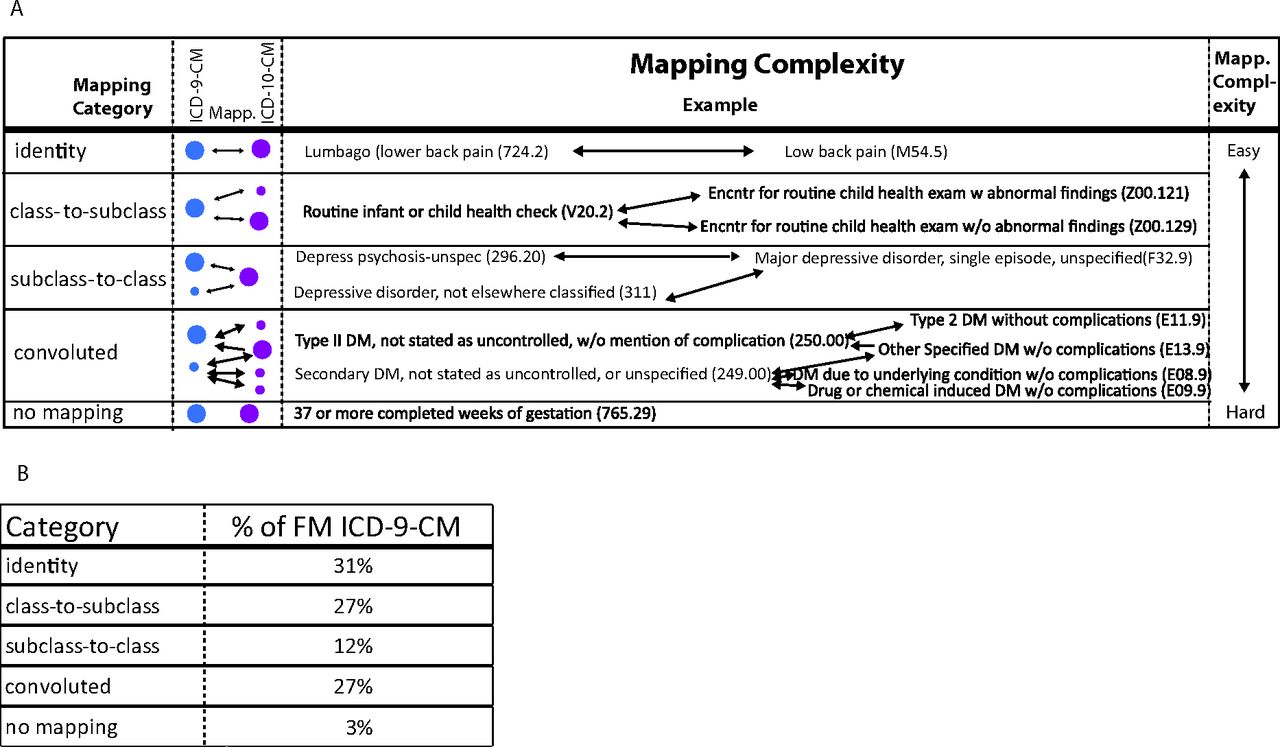
    Mapping complexity. Each International Classification of Diseases, 9th Revision, Clinical Modification (ICD-9-CM) diagnosis code was categorized into 1 of 5 categories. A: The blue circles represent ICD-9-CM codes and the purple circles represent International Classification of Diseases, 10th Revision, Clinical Modification (ICD-10-CM) diagnosis codes. The smaller circles represent secondary codes that are related to the category but have separate analysis as a primary code elsewhere. The arrows between the circles represent the mapping by the GEM files provided by the government. Identity is the category where 1 code replaces another code. Class-to-subclass is where multiple ICD-10-CM codes are represented by a single ICD-9-CM diagnosis code. Additional documentation or detail is required. Subclass-to-class is where multiple ICD-9-CM codes are represented by a single ICD-10-CM code. Convoluted codes are nonreciprocal and have secondary codes confounding the diagnosis concepts. No mapping is where the GEM file does not provide a mapping to the ICD-10-CM codes. B: Categories represent the percentage of diagnosis codes used in the complete data set in each category.

  • Figure 2.
    • Download figure
    • Open in new tab
    Figure 2.

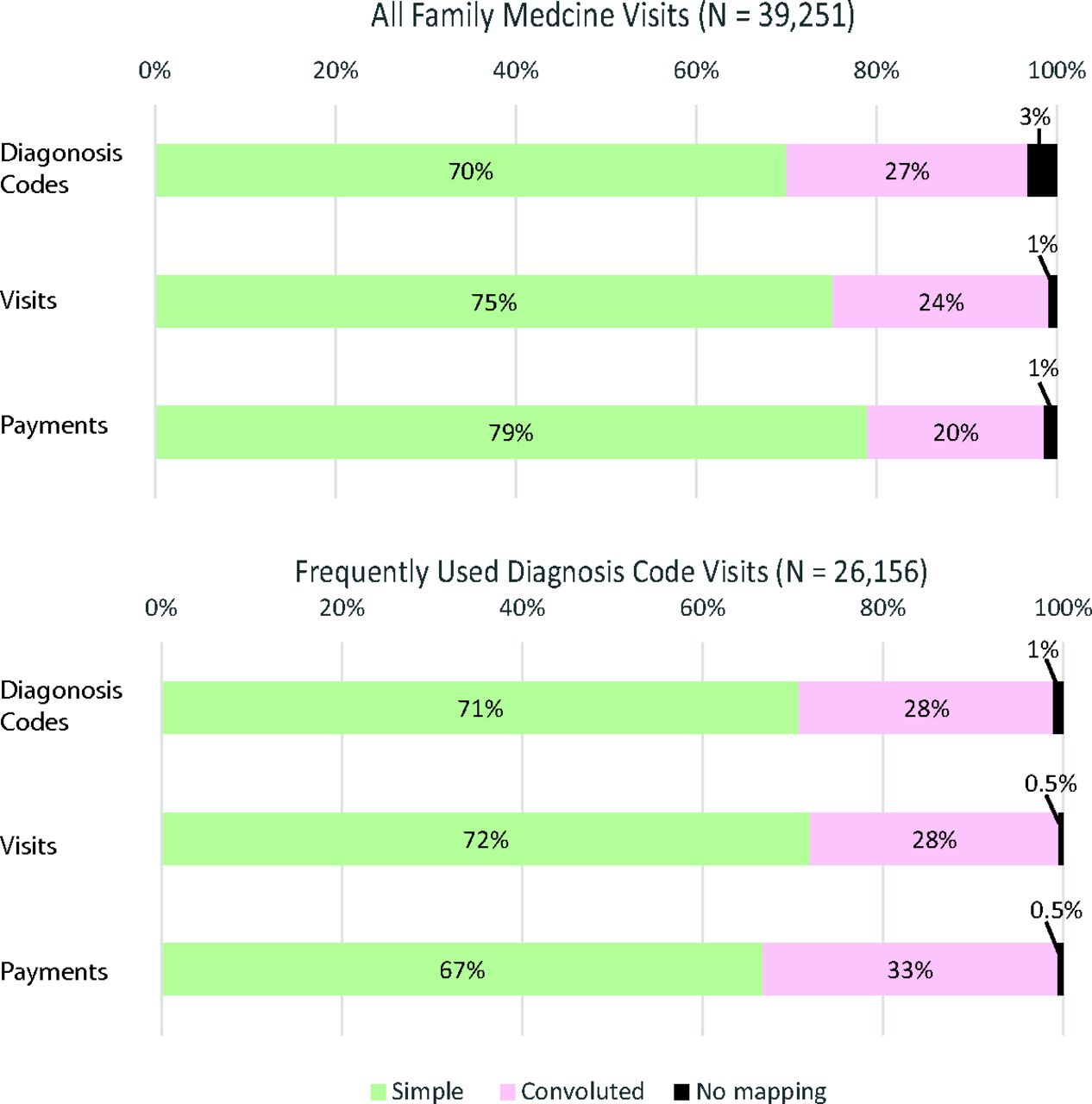
    Analysis of family medicine encounters. A: This graph analyzes all 39,251 encounters with family medicine physicians. The Diagnosis Codes graph counts each diagnosis code as a single value and categorizes all the codes as a percentage of the total number of codes. The Visits graph analyses all the visits for a specific diagnosis code and calculates a percentage of total number of visits. The simple diagnosis codes account for more visits than the convoluted codes. The Payments analysis takes the payments for each diagnosis code and categorizes them into the simple or convoluted diagnosis code category and divides by the total amount of reimbursement. B: A secondary analysis of all diagnosis codes used >25 times was performed and included a total of 26,156 visits. The percentages are nearly equivalent to the complete representation of visits.
Tables

  • Figures
    • View popup
    Table 1. Convoluted International Classification of Diseases, 9th Revision, Clinical Modification Codes with Clinically Incorrect Mappings to International Classification of Diseases, 10th Revision, Clinical Modification
    ICD-9-CM CodeICD-9-CM Code Name
    250.02*Type II diabetes mellitus (non-insulin dependent type) (NIDDM type) (adult-onset type) or unspecified type, uncontrolled, without mention of complication
    625.9*Unspecified symptom associated with female genital organs
    719.44*Joint pain—hand
    V06.8Need for prophylactic vaccination and inoculation against other combinations of diseases
    V70.2General psychiatric examination, other and unspecified
    648.83Abnormal glucose tolerance of mother, antepartum
    919.4Insect bite, nonvenomous, of other, multiple, and unspecified sites, without mention of infection
    719.44Joint pain—hand
    780.79Other malaise and fatigue
    787.91Diarrhea
    292.0Drug withdrawal
    682.0Cellulitis and abscess of face
    V07.31Need for prophylactic fluoride administration
    789.09Abdominal pain, other specified site
    • ↵* All International Classification of Diseases, 9th Revision, Clinical Modification (ICD-9-CM) codes had two family medicine physicians agree the mapping was incorrect.

    • NIDDM, non-insulin-dependent diabetes mellitus.

    • View popup
    Table 2. Convoluted High-Frequency Codes
    959.01Head injury NOS
    V07.31Need for prophylactic fluoride administration
    V04.81Need for prophylactic vaccination and inoculation against influenza
    250.00Type II diabetes mellitus (non-insulin dependent type) (NIDDM type) (adult-onset type) or unspecified type, not stated as uncontrolled, without mention of complication
    799.9Other unknown and unspecified cause of morbidity or mortality
    250.02Type II diabetes mellitus (non-insulin dependent type) (NIDDM type) (adult-onset type) or unspecified type, uncontrolled, without mention of complication
    V03.2Need for prophylactic vaccination with tuberculosis (BCG) vaccine
    292.0Drug withdrawal
    V06.1Need for prophylactic vaccination with combined diphtheria-tetanus-pertussis (DTP) (DTaP) vaccine
    314.00Attention deficit disorder of childhood without mention of hyperactivity
    V70.5Health examination of defined subpopulations
    314.01Attention deficit disorder of childhood with hyperactivity
    883.0Open wound of fingers, without mention of complication
    388.70Otalgia NOS
    959.4Other and unspecified injury to hand, except finger
    466.0Acute bronchitis
    V03.82Need for prophylactic vaccination against Streptococcus pneumoniae (pneumococcus)
    518.81Acute respiratory failure
    V05.3Need for prophylactic vaccination and inoculation against viral hepatitis
    558.9Other and unspecified noninfectious gastroenteritis and colitis
    V06.8Need for prophylactic vaccination and inoculation against other combinations of diseases
    625.9Unspecified symptom associated with female genital organs
    V70.2General psychiatric examination, other and unspecified
    626.4Irregular menstrual cycle
    789.09Abdominal pain, other specified site; multiple sites
    626.9Unspecified disorders of menstruation and other abnormal bleeding from female genital tract
    845.00Sprain of ankle NOS
    648.83Abnormal glucose tolerance of mother, antepartum
    919.4Insect bite, nonvenomous, of other, multiple, and unspecified sites, without mention of infection
    649.13Obesity complicating pregnancy, childbirth, or the puerperium, antepartum condition or complication
    959.3Other and unspecified injury to elbow, forearm, and wrist
    682.0Cellulitis and abscess of face
    959.5Other and unspecified injury to finger
    682.6Cellulitis and abscess of leg, except foot
    V03.81Need for prophylactic vaccination against Haemophilus influenzae, type B (Hib)
    682.7Cellulitis and abscess of foot, except toes
    V03.89Need for other specified vaccination against single bacterial disease
    715.90Osteoarthrosis, unspecified whether generalized or localized, involving unspecified site
    V04.89Need for prophylactic vaccination and inoculation against other viral diseases
    729.5Pain in limb
    V05.4Need for prophylactic vaccination and inoculation against varicella
    780.60Fever NOS
    V06.4Need for prophylactic vaccination with measles-mumps-rubella (MMR) vaccine
    780.79Other malaise and fatigue
    V06.9Need for prophylactic vaccination with unspecified combined vaccine
    781.0Abnormal involuntary movements
    V70.0Routine general medical examination at a health care facility
    786.09Other dyspnea and respiratory abnormality
    V70.3Other general medical examination for administrative purposes
    787.03Vomiting alone
    V70.9Unspecified general medical examination
    787.91Diarrhea
    719.44Joint pain—hand
    • BCG, Bacillus Calmette–Guérin; NIDDM, non-insulin-dependent diabetes mellitus; NOS, not otherwise specified.
PreviousNext
Back to top

In this issue

The Journal of the American Board of Family     Medicine: 29 (1)
The Journal of the American Board of Family Medicine
Vol. 29, Issue 1
January-February 2016
  • Table of Contents
  • Table of Contents (PDF)
  • Cover (PDF)
  • Index by author
  • Back Matter (PDF)
  • Front Matter (PDF)
Print
Download PDF
Article Alerts
Sign In to Email Alerts with your Email Address
Email Article

Thank you for your interest in spreading the word on American Board of Family Medicine.

NOTE: We only request your email address so that the person you are recommending the page to knows that you wanted them to see it, and that it is not junk mail. We do not capture any email address.

Enter multiple addresses on separate lines or separate them with commas.
Simulation of ICD-9 to ICD-10-CM Transition for Family Medicine: Simple or Convoluted?
(Your Name) has sent you a message from American Board of Family Medicine
(Your Name) thought you would like to see the American Board of Family Medicine web site.
CAPTCHA
This question is for testing whether or not you are a human visitor and to prevent automated spam submissions.
1 + 10 =
Solve this simple math problem and enter the result. E.g. for 1+3, enter 4.
Citation Tools
Simulation of ICD-9 to ICD-10-CM Transition for Family Medicine: Simple or Convoluted?
Samuel N. Grief, Jesal Patel, Karl M. Kochendorfer, Lee A. Green, Yves A. Lussier, Jianrong Li, Michael Burton, Andrew D. Boyd
The Journal of the American Board of Family Medicine Jan 2016, 29 (1) 29-36; DOI: 10.3122/jabfm.2016.01.150146

Citation Manager Formats

  • BibTeX
  • Bookends
  • EasyBib
  • EndNote (tagged)
  • EndNote 8 (xml)
  • Medlars
  • Mendeley
  • Papers
  • RefWorks Tagged
  • Ref Manager
  • RIS
  • Zotero
Share
Simulation of ICD-9 to ICD-10-CM Transition for Family Medicine: Simple or Convoluted?
Samuel N. Grief, Jesal Patel, Karl M. Kochendorfer, Lee A. Green, Yves A. Lussier, Jianrong Li, Michael Burton, Andrew D. Boyd
The Journal of the American Board of Family Medicine Jan 2016, 29 (1) 29-36; DOI: 10.3122/jabfm.2016.01.150146
Twitter logo Facebook logo Mendeley logo
  • Tweet Widget
  • Facebook Like
  • Google Plus One

Jump to section

  • Article
    • Abstract
    • Methods
    • Results
    • Discussion
    • Notes
    • References
  • Figures & Data
  • References
  • Info & Metrics
  • PDF

Related Articles

  • No related articles found.
  • PubMed
  • Google Scholar

Cited By...

  • Family Medicine Research That Provides Compelling, Urgent Data to Improve Patient Care
  • Google Scholar

More in this TOC Section

  • How High-Performing Community Health Clinics Accomplish Social Risk Screening
  • Barriers and Facilitators to Screening for Anxiety and Intimate Partner Violence
  • Teens' Time Alone with Their Clinician: Receipt of Health Care Transition Preparation and Anticipatory Guidance
Show more Original Research

Similar Articles

Keywords

  • Clinical Coding
  • Electronic Medical Records
  • Family Practice
  • Medical Informatics

Navigate

  • Home
  • Current Issue
  • Past Issues

Authors & Reviewers

  • Info For Authors
  • Info For Reviewers
  • Submit A Manuscript/Review

Other Services

  • Get Email Alerts
  • Classifieds
  • Reprints and Permissions

Other Resources

  • Forms
  • Contact Us
  • ABFM News

© 2026 American Board of Family Medicine

Powered by HighWire