
Main menu

  • HOME
  • ARTICLES
    • Current Issue
    • Abstracts In Press
    • Archives
    • Special Issue Archive
    • Subject Collections
  • INFO FOR
    • Authors
    • Reviewers
    • Call For Papers
    • Subscribers
    • Advertisers
  • SUBMIT
    • Manuscript
    • Peer Review
  • ABOUT
    • The JABFM
    • The Editing Fellowship
    • Editorial Board
    • Indexing
    • Editors' Blog
  • CLASSIFIEDS
  • Other Publications
    • abfm

User menu

Search

  • Advanced search
American Board of Family Medicine
  • Other Publications
    • abfm
American Board of Family Medicine

American Board of Family Medicine

Advanced Search

  • HOME
  • ARTICLES
    • Current Issue
    • Abstracts In Press
    • Archives
    • Special Issue Archive
    • Subject Collections
  • INFO FOR
    • Authors
    • Reviewers
    • Call For Papers
    • Subscribers
    • Advertisers
  • SUBMIT
    • Manuscript
    • Peer Review
  • ABOUT
    • The JABFM
    • The Editing Fellowship
    • Editorial Board
    • Indexing
    • Editors' Blog
  • CLASSIFIEDS
  • JABFM on Bluesky
  • JABFM On Facebook
  • JABFM On Twitter
  • JABFM On YouTube
Research ArticleOriginal Research

Symptom Burden Among Cancer Survivors: Impact of Age and Comorbidity

Jun J. Mao, Katrina Armstrong, Marjorie A. Bowman, Sharon X. Xie, Rachel Kadakia and John T. Farrar
The Journal of the American Board of Family Medicine September 2007, 20 (5) 434-443; DOI: https://doi.org/10.3122/jabfm.2007.05.060225
Jun J. Mao
MD, MSCE
  • Find this author on Google Scholar
  • Find this author on PubMed
  • Search for this author on this site
Katrina Armstrong
MD, MSCE
  • Find this author on Google Scholar
  • Find this author on PubMed
  • Search for this author on this site
Marjorie A. Bowman
MD, MPA
  • Find this author on Google Scholar
  • Find this author on PubMed
  • Search for this author on this site
Sharon X. Xie
PhD
  • Find this author on Google Scholar
  • Find this author on PubMed
  • Search for this author on this site
Rachel Kadakia
BA
  • Find this author on Google Scholar
  • Find this author on PubMed
  • Search for this author on this site
John T. Farrar
MD, PhD
  • Find this author on Google Scholar
  • Find this author on PubMed
  • Search for this author on this site
  • Article
  • Figures & Data
  • References
  • Info & Metrics
  • PDF
Loading

Article Figures & Data

Figures

  • Tables
  • Figure 1.
    • Download figure
    • Open in new tab
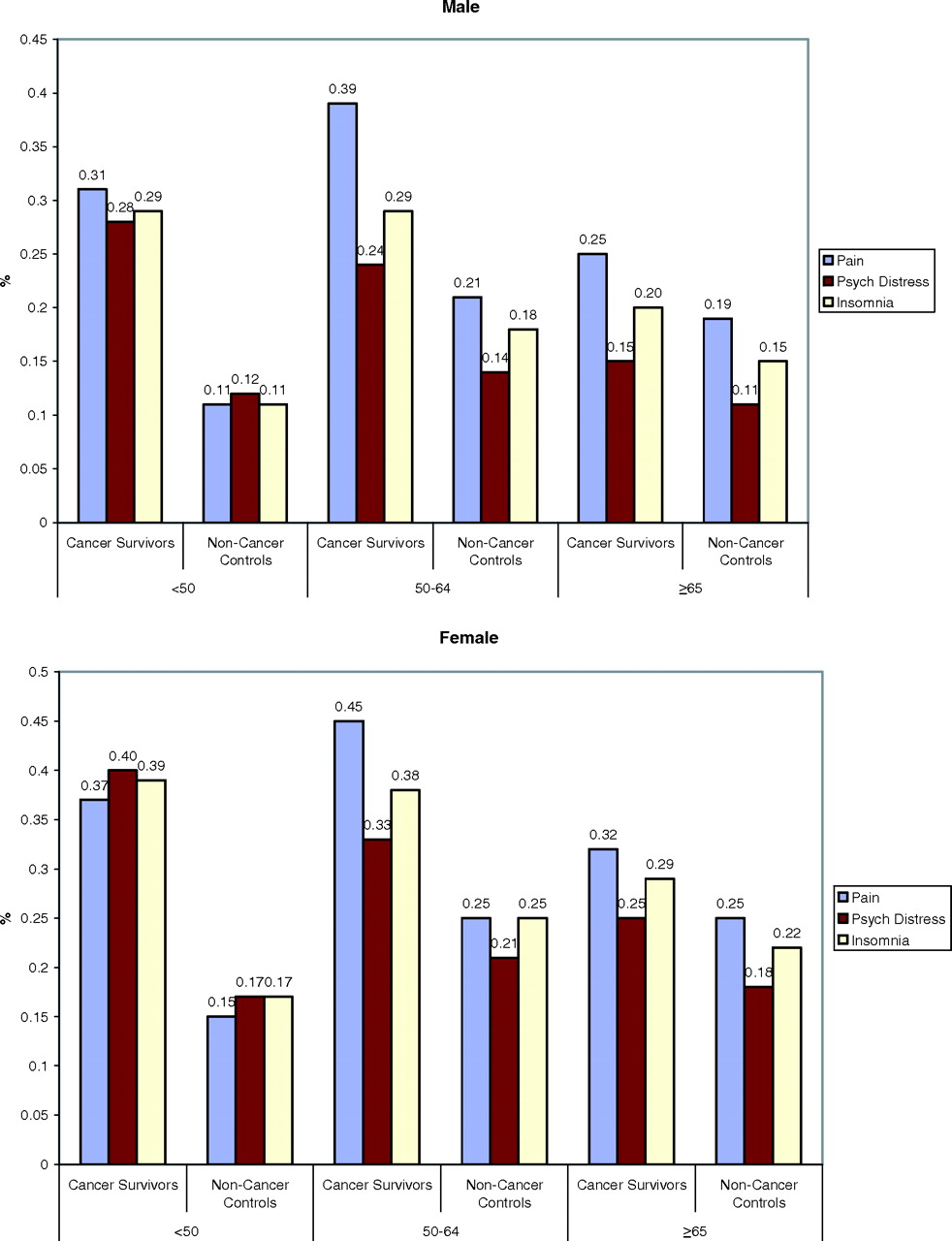
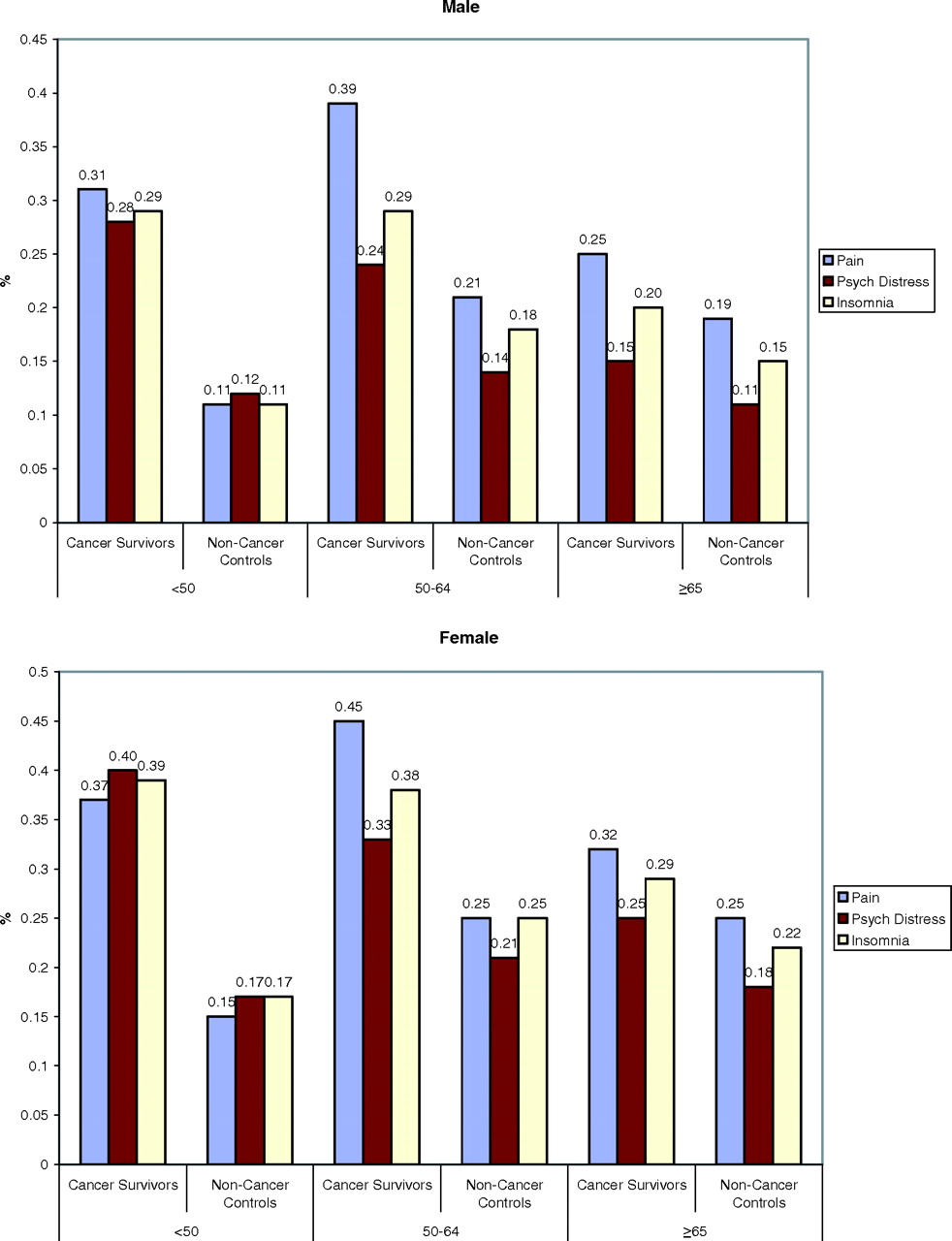
    Figure 1.

    Probability of ongoing symptoms stratified by cancer survivorship, age, and sex. The final model included cancer survivorship, age, sex, education, race/ethnicity, and income (see Table 2). Average prediction was based on this model stratified by cancer survivor status, age, and sex.
Tables

  • Figures
    • View popup
    Table 1.

    Sociodemographic Characteristics of Respondents With and Without a History of Cancer

    CharacteristicsCancer Survivors (n = 1,904)General Population Controls (n = 29,092)P*
    Age (years)
        <5022.965.3<.001
        50 to 6426.920.8
        ≥6550.213.9
    Sex
        Male41.248.4<.001
        Female58.851.6
    Education attainment
        High school graduate or less52.446.1<.001
        Some college or technical school27.429.2
        College or more advanced degree20.224.7
    Race/ethnicity
        Hispanic3.811.5<.001
        Non-Hispanic white89.072.2
        Non-Hispanic black5.411.7
        Other (non-Hispanic)1.84.6
    Marital status
        Currently married/living with partner64.263.80.74
        Not currently married/partnered35.836.3
    Annual household income
        <$20,00024.619.1<.001
        ≥$20,00075.480.9
    Comorbid conditions
        None39.276.4<.001
        One39.118.1
        Two12.23.9
        Three or more9.51.6
    Time since cancer diagnosis (years)
        118.4
        2 to 529.8
        6 to 1018.7
        ≥1133.1
    • Data source: National Health Interview Survey 2002; weighted percentages were extrapolated from the US census (2000) for the adult civilian. All data presented as percentages.

    • * Categorical variables were compared with univariate logistic regression; P values are two-sided.

    • View popup
    Table 2.

    Symptom Burden Among Cancer Survivors Differs by Age

    CharacteristicsPainPsychological DistressInsomnia
    OR95% CIPOR95% CIPOR95% CIP
    CS versus control (unadjusted)2.442.16–2.74<.0011.981.76–2.22<.0012.091.83–2.38<.001
    Age (years)
        <502.962.28–3.85<.0012.942.35–3.67<.0012.702.09–3.48<.001
        50 to 642.231.76–2.83<.0011.841.45–2.34<.0011.801.40–2.31<.001
        >641.361.14–1.63.0011.481.23–1.79<.0011.441.18–1.75<.001
    Sex (female vs male)1.241.15–1.32<.0011.511.39–1.64<.0011.471.37–1.59<.001
    Education
        High school or less*111
        Some college0.980.90–1.06.560.860.79–0.94.0011.010.92–1.10.877
        College or more advanced0.730.66–0.81<.0010.570.51–0.64<.0010.700.63–0.76<.001
    Race/ethnicity
        Non-Hispanic white*111
        Non-Hispanic black0.840.75–0.94.0030.900.80–1.02.1020.780.70–0.88<.001
        Hispanic0.550.48–0.63<.0010.850.75–0.96.0070.770.69–0.87<.001
        Other (non-Hispanic)0.620.49–0.78<.0010.670.52–0.86.0020.570.45–0.72<.001
    Annual household income
        (<$20,000 vs. ≥$20,000)1.371.25–1.51<.0011.851.69–2.04<.0011.521.39–1.67<.001
    • * Models included cancer survivor status and age as interaction terms and controlled for sex, education, race/ethnicity, and income.

    • CS, cancer survivors; OR, odds ratio; CI, confidence interval.

    • View popup
    Table 3.

    Comorbidity and Increased Symptom Burden Among Cancer Survivors

    Comorbidities* (n)PainPsychological DistressInsomnia
    ControlCSControlCSControlCS
    01 (1.00–1.00)2.23 (1.73–2.86)1 (1.00–1.00)2.37 (1.86–3.00)1 (1.00–1.00)2.38 (1.86–3.03)
    17.44 (6.67–8.29)10.02 (8.08–12.43)3.37 (3.08–3.70)4.57 (3.71–5.61)3.52 (3.21–3.86)4.54 (3.64–5.66)
    215.44 (13.33–17.87)17.39 (12.95–23.35)5.62 (4.90–6.43)7.38 (5.46–9.99)6.38 (5.57–7.30)7.71 (5.60–10.60)
    3+27.34 (22.49–33.23)35.56 (25.34–49.91)11.26 (9.37–13.54)15.12 (11.08–20.64)9.92 (8.36–11.78)10.25 (7.40–14.21)
    • Models included comorbidity and cancer survivor status as interaction terms and were controlled for age, sex, education, race/ethnicity, and income. Data presented as odds ratios (95% confidence intervals).

    • * Comorbidities were measured by the number of health conditions causing functional limitations.

    • CS, cancer survivors.

    • View popup
    Table 4.

    Symptom Burden by Cancer Type and Time Since Cancer Diagnosis, Adjusted for Age, Education, Race/Ethnicity, and Income

    PainPsychological DistressInsomnia
    Cancer type*
        Breast (reference)1.001.001.00
        Cervix1.10 (0.71–1.71)1.86 (1.17–2.96)‡1.63 (1.05–2.53)†
        Uterine1.22 (0.75–1.99)2.08 (1.25–3.46)‡1.63 (1.00–2.65)†
        Prostate1.06 (0.68–1.63)0.82 (0.47–1.41)0.58 (0.36–0.95)†
        Colorectal0.95 (0.59–1.53)1.00 (0.58–1.71)0.77 (0.47–1.27)
        Melanoma0.87 (0.52–1.46)0.92 (0.50–1.68)0.62 (0.35–1.09)
        Multiple1.82 (1.21–2.74)†2.44 (1.56–3.80)‡1.13 (0.74–1.74)
        Other1.13 (0.83–1.55)1.45 (1.02–2.07)†0.91 (0.66–1.26)
    Time since diagnosis
        0 to 1 year (reference)1.001.001.00
        2 to 5 years0.83 (0.61–1.13)0.76 (0.55–1.06)0.66 (0.48–0.90)‡
        6 to 10 years0.99 (0.70–1.40)0.71 (0.49–1.04)0.63 (0.44–0.90)‡
        11 years or greater1.06 (0.78–1.45)0.98 (0.70–1.36)0.72 (0.52–0.98)†
    • Analysis included only cancer survivors. Data presented as odds ratios (95% confidence intervals).

    • * Because several cancer types are sex specific, the models did not include sex as a covariate.

    • † P <.05.

    • ‡ P <.01.

PreviousNext
Back to top

In this issue

The Journal of the American Board of Family Medicine: 20 (5)
The Journal of the American Board of Family Medicine
Vol. 20, Issue 5
September-October 2007
  • Table of Contents
  • Index by author
Print
Download PDF
Article Alerts
Sign In to Email Alerts with your Email Address
Email Article

Thank you for your interest in spreading the word on American Board of Family Medicine.

NOTE: We only request your email address so that the person you are recommending the page to knows that you wanted them to see it, and that it is not junk mail. We do not capture any email address.

Enter multiple addresses on separate lines or separate them with commas.
Symptom Burden Among Cancer Survivors: Impact of Age and Comorbidity
(Your Name) has sent you a message from American Board of Family Medicine
(Your Name) thought you would like to see the American Board of Family Medicine web site.
CAPTCHA
This question is for testing whether or not you are a human visitor and to prevent automated spam submissions.
5 + 3 =
Solve this simple math problem and enter the result. E.g. for 1+3, enter 4.
Citation Tools
Symptom Burden Among Cancer Survivors: Impact of Age and Comorbidity
Jun J. Mao, Katrina Armstrong, Marjorie A. Bowman, Sharon X. Xie, Rachel Kadakia, John T. Farrar
The Journal of the American Board of Family Medicine Sep 2007, 20 (5) 434-443; DOI: 10.3122/jabfm.2007.05.060225

Citation Manager Formats

  • BibTeX
  • Bookends
  • EasyBib
  • EndNote (tagged)
  • EndNote 8 (xml)
  • Medlars
  • Mendeley
  • Papers
  • RefWorks Tagged
  • Ref Manager
  • RIS
  • Zotero
Share
Symptom Burden Among Cancer Survivors: Impact of Age and Comorbidity
Jun J. Mao, Katrina Armstrong, Marjorie A. Bowman, Sharon X. Xie, Rachel Kadakia, John T. Farrar
The Journal of the American Board of Family Medicine Sep 2007, 20 (5) 434-443; DOI: 10.3122/jabfm.2007.05.060225
Twitter logo Facebook logo Mendeley logo
  • Tweet Widget
  • Facebook Like
  • Google Plus One

Jump to section

  • Article
    • Abstract
    • Methods
    • Results
    • Discussion
    • Notes
    • References
  • Figures & Data
  • References
  • Info & Metrics
  • PDF

Related Articles

  • No related articles found.
  • PubMed
  • Google Scholar

Cited By...

  • Multimorbidity in patients living with and beyond cancer: protocol for a scoping review
  • Patterns of Symptoms Burden in Neuroendocrine Tumors: A Population-Based Analysis of Prospective Patient-Reported Outcomes
  • Looking Back, Looking Forward: The Ethical Framing of Complementary and Alternative Medicine in Oncology Over the Last 20 Years
  • Differential Impact of Symptom Prevalence and Chronic Conditions on Quality of Life in Cancer Survivors and Non-Cancer Individuals: A Population Study
  • Patient-Controlled Analgesia for Cancer-Related Pain: Clinical Predictors of Patient Outcomes
  • Psychological and Behavioral Approaches to Cancer Pain Management
  • Neuroinflammation and Comorbidity of Pain and Depression
  • Management of Unexplained Symptoms in Survivors of Cancer
  • Self-Reported Health Problems of Young Adults in Clinical Settings: Survivors of Childhood Cancer and Healthy Controls
  • Delivery of Survivorship Care by Primary Care Physicians: The Perspective of Breast Cancer Patients
  • Google Scholar

More in this TOC Section

  • Menstrual Equity: A Survey Study with ZIP-Code Level Analysis
  • Safeguarding Compassion in Virtual Family Physician Care
  • Industry Interactions at Medical Conferences: Representatives’ Credentials and the Disclosure of Data Limitations Influence Clinician Perceptions
Show more Original Research

Similar Articles

Navigate

  • Home
  • Current Issue
  • Past Issues

Authors & Reviewers

  • Info For Authors
  • Info For Reviewers
  • Submit A Manuscript/Review

Other Services

  • Get Email Alerts
  • Classifieds
  • Reprints and Permissions

Other Resources

  • Forms
  • Contact Us
  • ABFM News

© 2025 American Board of Family Medicine

Powered by HighWire